Understanding this Keyword in JavaScript

You entered your interview room and the gatekeeper asks:
“Who called you?”
You show him the invitation letter, and he points you toward the interviewer.
That’s basically how this works in JavaScript.
The this keyword points to the object that invoked (called) the function.
Whenever a function is called, JavaScript internally asks:
“Who called this function?”
The answer becomes the value of this.
1. Global Context
In the global context, without any function call, this points to the global object of the environment.
Browser Environment
In browsers, the global object is window.
console.log(this);
Output
Window
Node.js Environment
Node.js behaves differently.
Node wraps your code inside a module wrapper function before execution and sets this to module.exports.
console.log(this);
Output
{}
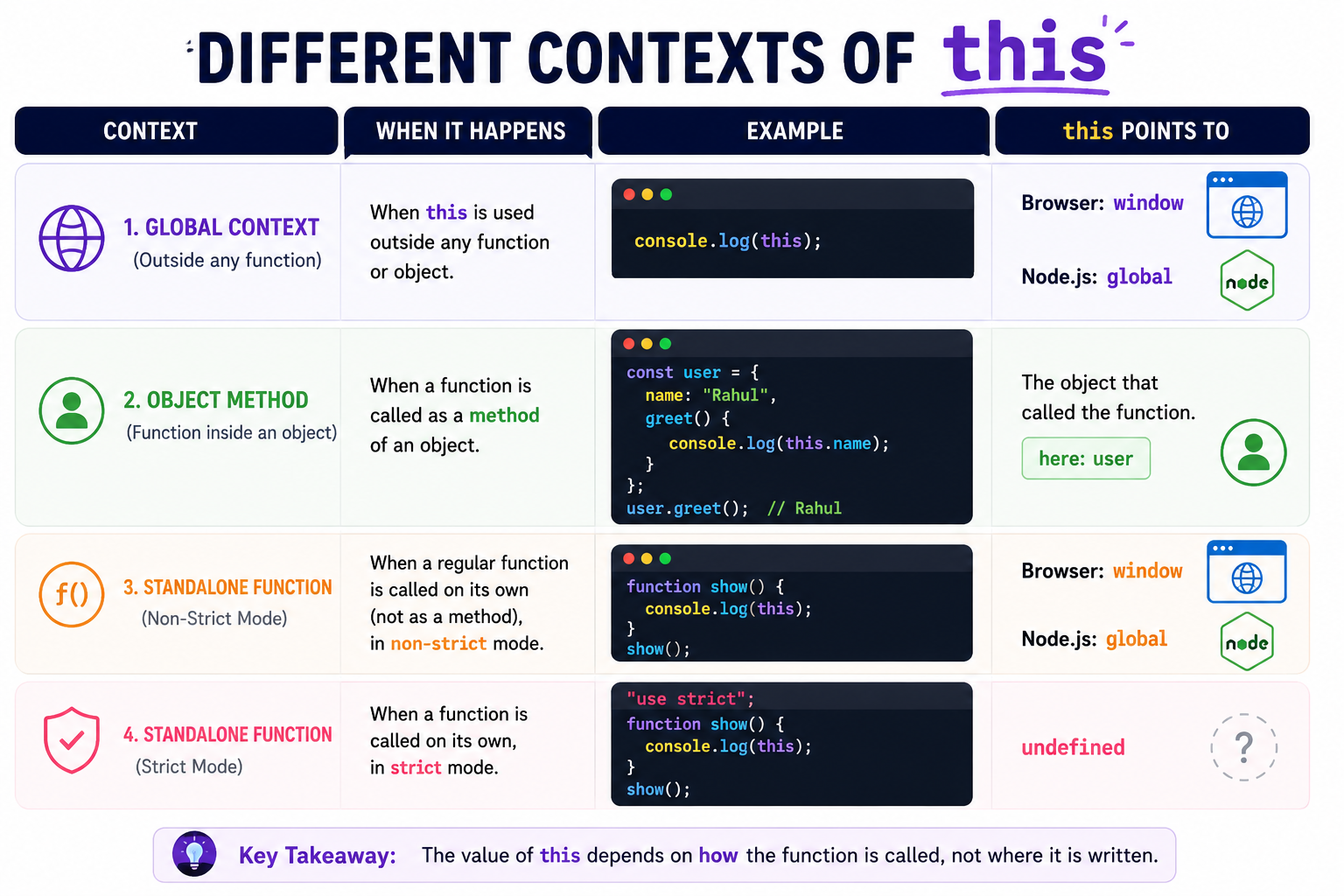
Different Contexts of this
Global Context  → Global Object

Object Method   → Calling Object

Standalone Function
  ├─ Non Strict → Global Object
  └─ Strict     → undefined
2. this Inside Objects
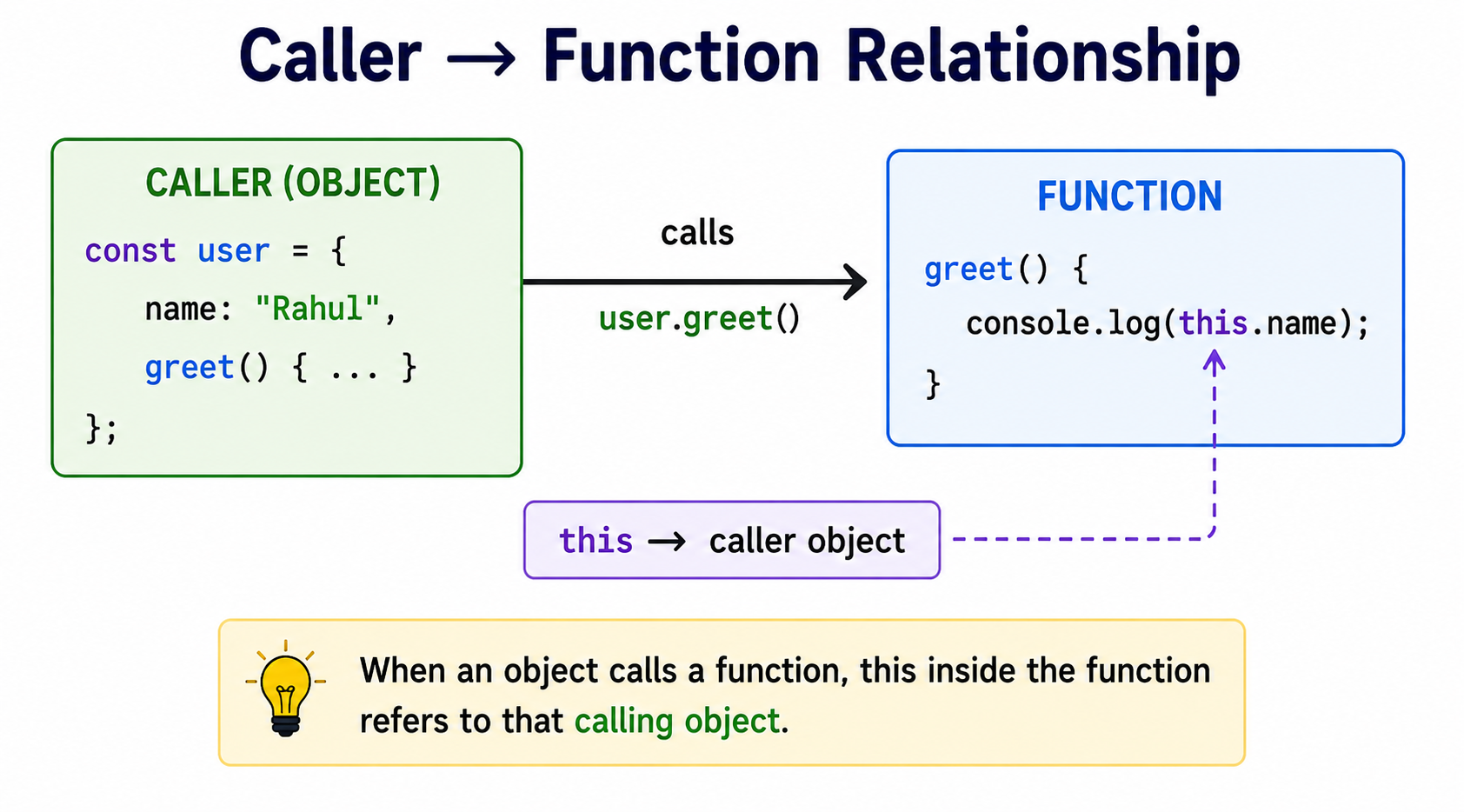
Since this points to the caller object, inside object methods it refers to the object that called the method.
const user = {
  name: "Rahul",

  greet() {
    console.log(this.name);
  }
};

user.greet();
Output
Rahul
Here:
this.name
ultimately becomes:
user.name
because user is the calling object.
Caller → Function Relationship
3. this Inside Functions
The value of this inside a function depends on how the function is called.
This is known as runtime binding.
3.1 Function Called Globally
If a function is called globally, then this behaves similarly to the global context.
Browser Environment
function show() {
  console.log(this);
}

show();
Output
Window
Node.js Environment
function show() {
  console.log(this);
}

show();
Output
{} // global object
Strict Mode
"use strict";

function show() {
  console.log(this);
}

show();
Output
undefined
3.2 Function as a Method of an Object
If a function is called as a method of an object, then this points to that object.
const person = {
  name: "Aman",

  sayHello() {
    console.log(this.name);
  }
};

person.sayHello();
Output
Aman
Here:
person ----calls----> sayHello()
           |
           ↓
         this
So:
this === person
How Calling Context Changes this
The same function can have different values of this depending on who calls it.
function greet() {
  console.log(this.name);
}

const user1 = {
  name: "Rahul",
  greet
};

const user2 = {
  name: "Aman",
  greet
};

user1.greet(); // Rahul
user2.greet(); // Aman
Visual Understanding
user1 ----calls----> greet()
           |
           ↓
      this = user1


user2 ----calls----> greet()
           |
           ↓
      this = user2
Key Rule to Remember
this is not decided where the function is written.
this is decided by:
How the function is called.
Quick Summary
| Context | Value of this |
|---|---|
| Global (Browser) | window |
| Global (Node.js) | {} / module.exports |
| Standalone Function (Non-Strict) | Global Object |
| Standalone Function (Strict) | undefined |
| Object Method | Calling Object |
| Method Shared Between Objects | Object That Calls It |
Final Takeaway
Whenever you get confused about this, ask:
“Who called the function?”
That caller becomes the value of this.


